

What the gate counts as a correction
The gate reads only the first sentence of what you typed, and only these shapes:
These never trip the gate:
- A question. If your first sentence asks, the turn is a question.
- An approval.
ship it,merge itandgo aheadread as verdicts on work you already filed. - A paste. A quote, a list or a table in the first position is a paste, not an order.
correct, a reject or a request blocks the turn.
Read the queue
What the agent runs
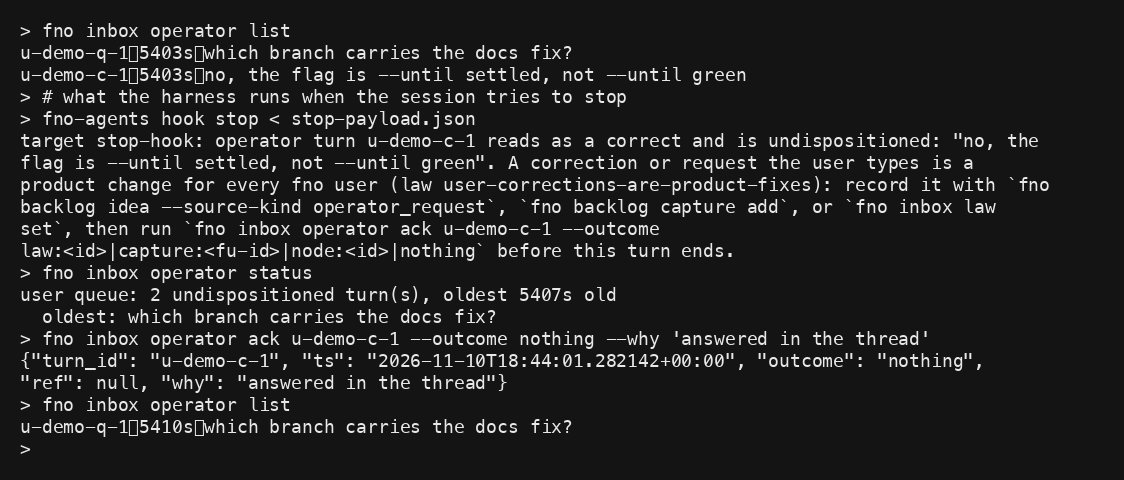
--all, a lead lists every session’s turns with their answer state. fno inbox operator status prints one line: the count and the oldest age.
Clear the refusal
When the gate refuses, the session prints a message like this one:What the agent runs
The agent files the correction the way you chose, then disposes the turn. The title summarizes what you typed:<TURN_ID> is the id from the refusal or from fno inbox operator list. <NODE_ID> is the id the record command printed. To record a capture item instead, the agent runs fno backlog capture add <TITLE> --source <SUBSTRATE> --why <TEXT>. To record a law, the agent asks for your exact words and runs fno inbox law set <SUBJECT> <DECISION> --quote "<YOUR_EXACT_WORDS>", as Answer and rule from chat shows. One outcome names what the turn produced:
The ack prints a one-line receipt and the turn leaves the queue. The same stop passes now, and the session ends its turn.
The lead check-in shows the queue
Each lead beat,fno agents lead checkin prints the queue with the session’s other readings:
fno inbox operator list, and prints the oldest turn’s words. A queue that old is how a correction comes back as a new bug days later, which is the failure the gate exists to end.
Stuck refusals
- The same turn still refuses. You acked a turn in another session. Each session has its own queue. Check the turn id against
fno inbox operator listin the session that refuses. - A question sits in the queue forever. That is expected. A question never blocks the stop. If you want the count to zero, ack it with
--outcome nothing.
Next steps
- Answer and rule from chat: record a law with your exact words.
- Work the backlog: turn the correction into a node with a plan.
- Command page: see the questions and answers that wait on you, by machine.