

fno agents spawn is a different surface: see a worker launch is refused.
What a refusal reads
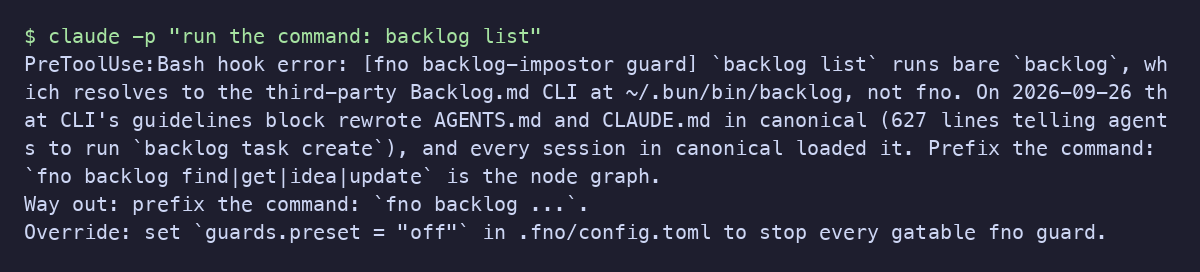
Every refusal has three lines:[fno <guard>]names fno as the refuser and the guard that spoke. Your harness renders a hook denial as its own permission denial. The tag tells you the denial is not the harness’s own decision.- The
Way outline is the safe form of the same intent. If you can, take it. - The
Overrideline tells you how to run the call anyway. If the guard is wrong for your case, use it.
A session you attend gets a question
On a Claude Code session you attend, the stop is a question, not a denial. The harness shows its own confirmation dialog and quotes the refusal: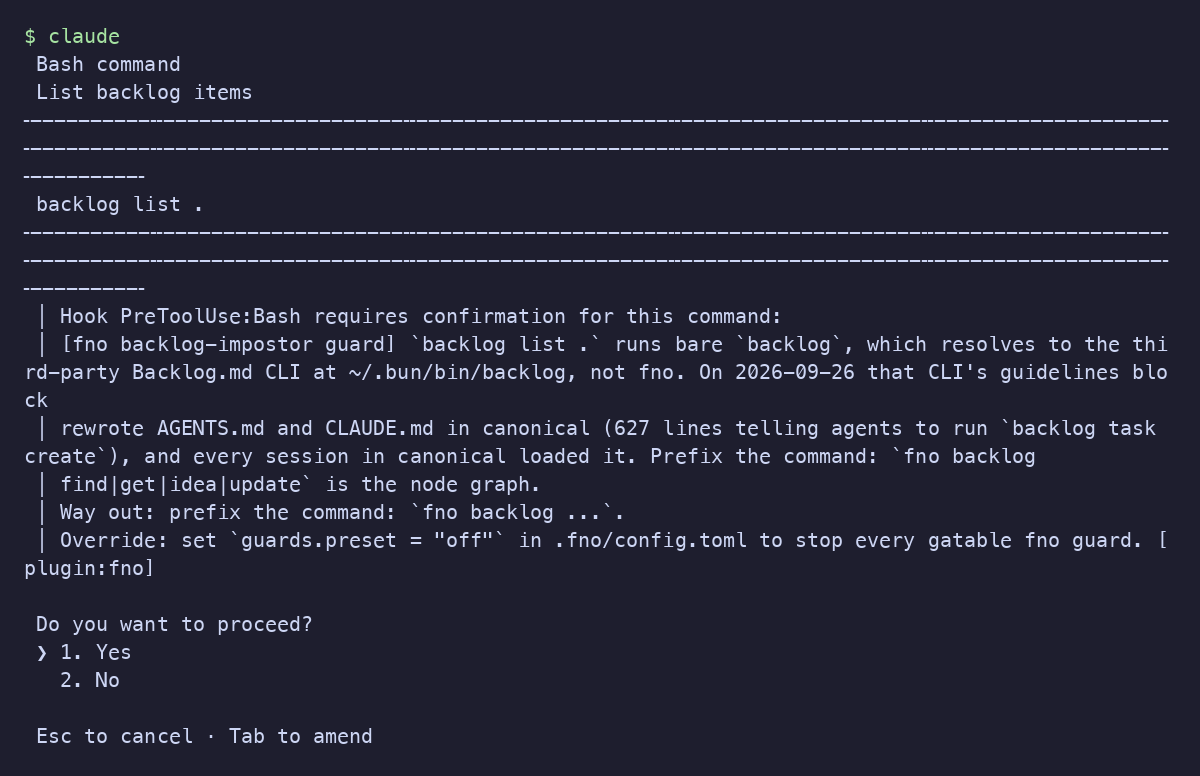
Read your overrides
Each approved call leaves one row per guard in the event journal. Each row names the guard, the tool, and the time. To read the rows, run:--since 2d to narrow the rows to a period. A guard you override in every session is a guard in your way. If one guard collects overrides across sessions, tell your lead. Or open an issue at github.com/fnodotdev/fno/issues. The configuration reference shows where .fno/config.toml sits and how settings merge.
Choose which guards run
Seven guards answer one setting,guards.preset in .fno/config.toml. A gatable guard is one the preset can turn off:
The guards that run only under
strict are recursive-grep guard, test-run guard, bin-install guard, and bg-process guard. The FNO_GUARD_PRESET environment variable wins over the config file. If the preset seems not to apply, check that variable. No setting turns one gatable guard off by name. Choose the preset that matches.
Some guards never gate on the preset:
The third identical failure parks
A Bash call that fails with the identical output twice parks on the third unchanged attempt. The refusal reads:Next steps
- Security posture: the trust boundary the guards sit inside.
- Troubleshoot F[no]: the symptom table for everything else that can go wrong.
- Configuration: where
.fno/config.tomlsits and how settings merge.